Contents
Gemini 4 Argon is Google's new frontier AI model, announced on September 30, 2026. It can write up to 1 million tokens in a single response, it leads several coding and automation benchmarks, and it is not available to the public yet: the first people to get it are vetted cybersecurity defenders. Paid API customers and Google AI Ultra subscribers are next, with no firm date.

Key Takeaways
- Google announced Gemini 4 Argon on September 30, 2026
- The output limit jumps from 64,000 tokens to 1 million
- Launch pricing is $2 per million input tokens and $10 per million output tokens, rising to $4 and $20 later
- Access starts with "trusted cyber defenders" in Google's Fairwind Program, who get the model without cyber guardrails
- It scored 77.9% on DeepSWE v1.1, ahead of Claude Opus 5.5 and GPT-6 Astra, but trails on some other tests
What is Gemini 4 Argon?
In the launch post, Google DeepMind's Koray Kavukcuoglu describes it as built for "complex workflows across real-world software engineering, enterprise knowledge work like legal and finance, and cybersecurity defense."
The pitch is less about better chat answers and more about long-running work. Google's own examples are all multi-hour engineering jobs:
- Data center memory: internal agents analyzed memory usage and freed more than 300 TiB across Google's data centers
- Code migration: a C++ to Rust migration scaled past 800,000 lines for the Fuchsia Zircon kernel
- Video decoding: a 2.7x speed-up on the libgav1 decoder with identical video output
- Security: in an example Google credits to Wiz, the model found a critical, previously unknown vulnerability in healthcare software used by hospitals worldwide, one that earlier frontier models had missed
What's new in Gemini 4 Argon?
A 1 million token output limit
Previous Gemini models could write about 64,000 tokens per response. Argon can write 1 million. In practice that means it can produce an entire codebase migration, a long legal review or a full report in one pass instead of stitching together dozens of smaller replies.
The trade-off is review. A response that long is hard for a human to check, which is why security researchers are already flagging that large outputs need tooling and process around them, not just trust.
Built to find and patch vulnerabilities
Google trained Argon specifically for cyber defense. According to The Hacker News, it outperforms Gemini 3.8 Flash Cyber, released only a month earlier, at discovering attack surfaces and producing working proof-of-concept validations. It can find, validate and patch critical flaws on its own.
That capability cuts both ways, and it explains the unusual rollout.
Gemini 4 Argon benchmarks
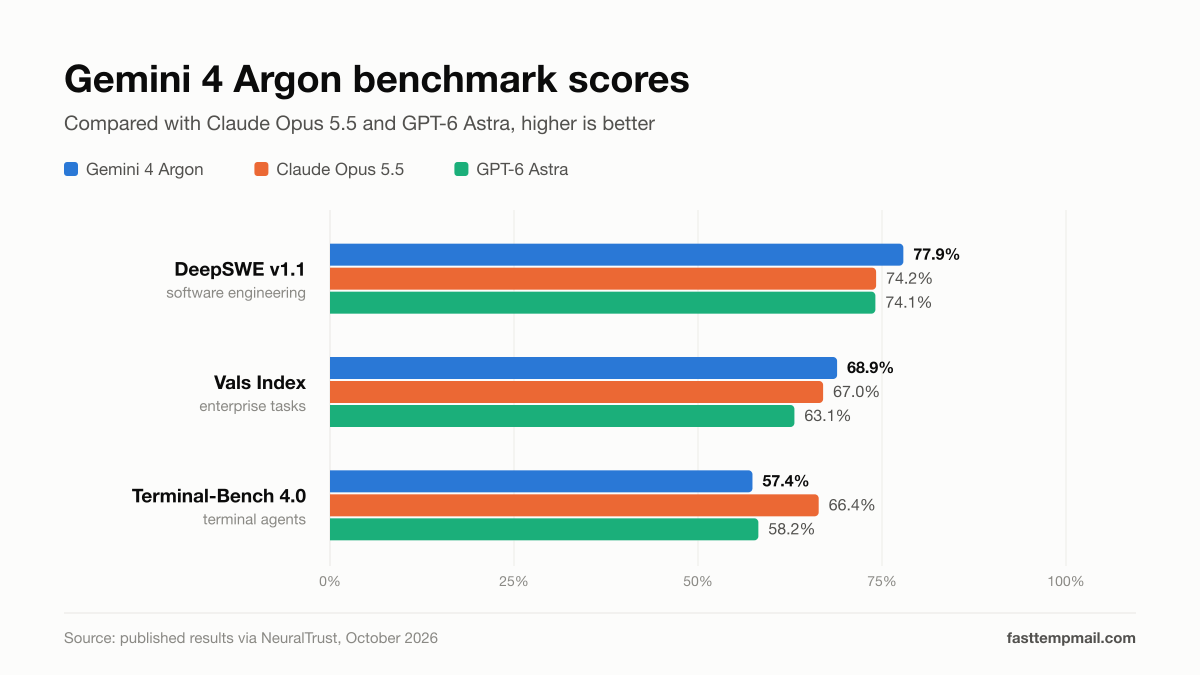
| Benchmark | Gemini 4 Argon | Claude Opus 5.5 | GPT-6 Astra |
|---|---|---|---|
| DeepSWE v1.1 (software engineering) | 77.9% | 74.2% | 74.1% |
| Vals Index | 68.9% | 67.0% | 63.1% |
| Terminal-Bench 4.0 | 57.4% | 66.4% | 58.2% |
| Artificial Analysis Intelligence | 52.6 | 57.6 | 52.7 |
Comparison figures are from NeuralTrust's analysis of the published results.
Argon also tied for first place on CWE-bench v1, a vulnerability remediation benchmark, at 68% alongside GPT-6 Astra and Grok 4.7. Google reports a 51.3% score on AutomationBench, which it says ranks first, and 91.7% on LVBench for long video understanding.
The honest reading: Argon leads on software engineering and long workflows, but it is not ahead everywhere. Claude Opus 5.5 still scores higher on Terminal-Bench 4.0 and on the Artificial Analysis index.
Why are cyber defenders getting it first?
A model that can find and exploit unknown vulnerabilities is useful to attackers too. Google's answer is the Fairwind Program, which gives vetted defensive security teams early access before anyone else.
Two details stand out:
- No cyber guardrails for trusted users. Google says trusted defenders and its own internal teams get Argon "without cyber guardrails so they can leverage its full frontier-level cybersecurity defense capabilities."
- Monitoring instead of blocking. Google describes misalignment mitigations that watch Argon's chain-of-thought and actions and stop execution when necessary, plus red-team testing and hardened sandboxes.
Everyone else will get a version with safeguards in place once Google has finished strengthening them.
How much does Gemini 4 Argon cost?
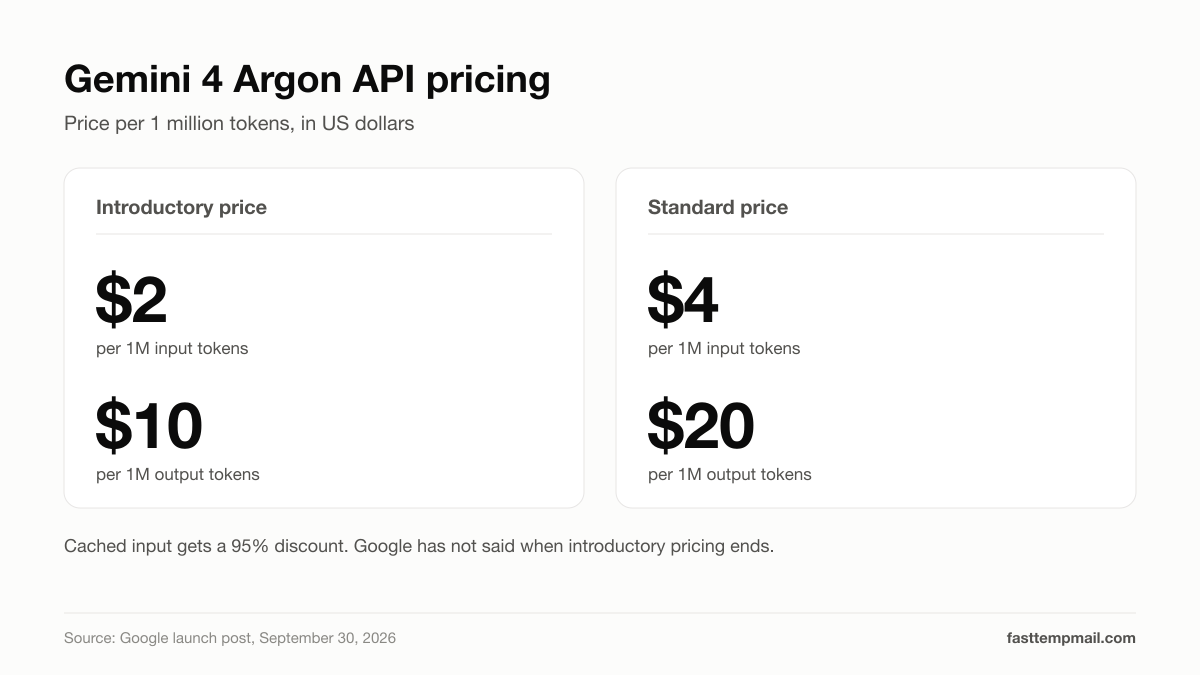
| Introductory price | Standard price | |
|---|---|---|
| Input (per 1M tokens) | $2 | $4 |
| Output (per 1M tokens) | $10 | $20 |
Cached input gets a 95% discount. Google has not said how long the introductory pricing lasts.
A full 1 million token response at the standard rate costs $20 in output alone, so the headline limit is something you will use deliberately, not by default.
When can you use Gemini 4 Argon?
- Now: trusted cyber defenders in the Fairwind Program
- Next: paid API customers and Google AI Ultra subscribers, "as soon as possible"
- Everyone else: no date announced
If you are on a free Gemini plan, expect to wait. Google has not said whether or when Argon reaches the free tier.
What this means for your online security
The same class of model that helps defenders patch software faster will eventually help attackers write more convincing phishing emails and find weak points faster. Our look at AI as the top cybersecurity risk of 2026 covers why that matters for ordinary users.
The practical defenses have not changed: use a password manager, turn on two-step verification, and stop handing your primary email address to every site that asks. For one-off signups and trials, a disposable inbox from FastTempMail keeps your real address out of the databases that get breached and scraped.
FAQ
When was Gemini 4 Argon released? Google announced Gemini 4 Argon on September 30, 2026. The first rollout is limited to trusted cyber defenders in the Fairwind Program. Paid API customers and Google AI Ultra subscribers follow "as soon as possible," and Google has not given a date for general availability.
How much does Gemini 4 Argon cost? Introductory API pricing is $2 per million input tokens and $10 per million output tokens, with a 95% discount on cached input. After the introductory period the price doubles to $4 per million input tokens and $20 per million output tokens.
Is Gemini 4 Argon better than GPT-6 Astra? It depends on the task. Argon scores 77.9% on DeepSWE v1.1 against 74.1% for GPT-6 Astra and leads the Vals Index, but the two are nearly level on Terminal-Bench 4.0 and the Artificial Analysis index, where Claude Opus 5.5 beats both.
Can I use Gemini 4 Argon for free? Not at launch. Access is limited to Fairwind Program members first, then paid API customers and Google AI Ultra subscribers. Google has not announced plans or timing for free Gemini users.
What is the Fairwind Program? Fairwind is Google's program for giving vetted cybersecurity defenders early access to frontier AI capabilities for defensive work. Members receive Gemini 4 Argon before the public and without the cyber guardrails that the general release will carry.
Also protect your IP address
NordVPN — audited no-logs policy, 111 countries. Sponsored
Share this article
Written by
Ajjlal Ahmed — creator of FastTempMail, a privacy-focused disposable email service. Passionate about tools that respect users.
View portfolioRelated articles
AI Is Now the Biggest Cybersecurity Risk of 2026, Says WEF
94% of organizations say AI is the top driver of cyber risk this year. Here's what the World Economic Forum's 2026 report reveals and how to stay safe.
GPT-5.5 Is Here: New Features, Fewer Hallucinations, and Computer Use
GPT-5.5 launched in April 2026 with native computer use, 52.5% fewer hallucinations in key domains, and memory transparency. Here's what changed.
YouTube Now Auto-Labels AI-Generated Videos: What Creators Need to Know
YouTube started automatically detecting and labeling AI-generated content in May 2026. Here's how the system works, what triggers it, and what creators should do.